Mount Everest stands the tallest mountain on our planet, and once discovered that it was, it became the world’s biggest challenge of reaching the top.
But one question has been continually asked throughout history: Why? Not only is this mountain the tallest in the world, but with over 300 deaths on this mountain it is also one of the most dangerous.

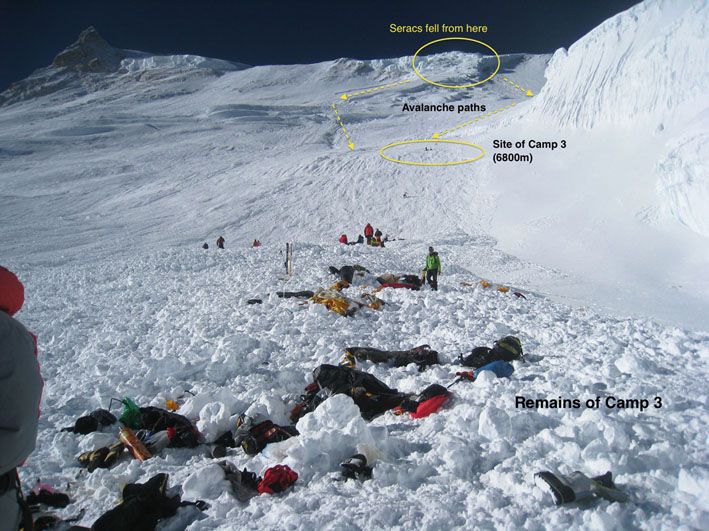
Nepal is known to have earthquakes, which can cause devastating results for climbers on Mount Everest such as avalanches. On April 25 of 2015 Nepal had a MW 7.8 earthquake, triggering a massive avalanche that killed 21 people.
The mountain is so dangerous that there is an area named “Rainbow valley” that holds the frozen corpses of those who never made it up(or down) the summit. Their colorful jackets littered in the valley is what makes it “Rainbow”.
Tragic events are known to take place on this mountain, the most controversial being the “1996 Mount Everest Disaster” which was documented and written about by journalist and mountaineer Jon Krakauer, who experienced this tragedy first hand.
The novel Into Thin Air, a story based on the tragically true events that happened in 1996 proves that we as humans cannot take “no” as an answer.

Ngawang Topche, a climber featured in Jon Krakauer’s Into Thin Air demonstrates a very persistent and selfless attitude during this tragedy. During the ascent up the Mountain, Ngawang begins to feel the effects of altitude sickness and high altitude pulmonary edema. However, his conditions worsen as his group reaches camp two. Ngawang develops very self destructive behavior as he goes against medical advice, takes off his oxygen mask, and pushes himself too his limit. Denying the fact that he has severe health problems, Ngawang pushed his body to the tipping point in the hopes of overcoming a goal. This trip up to the summit ultimately costed him his life.
We are told by our parents, teachers, coaches and peers to always “chase your dreams” and “challenge the impossible”. But the problem with this is that if you give someone too much faith then they become overconfident and don’t know when to stop.
Although it is wrong to tell someone to chase their dreams, you should also know when to stop and when to put your health and well being first.
Many mountaineers who attempted to climb the tallest summit faced their unfortunate deaths in the process of doing the extreme; something they knew was deadly and still continued to try.
(References) Click here for more on
Mount Everest: https://www.nepalsanctuarytreks.com/mount-everest-facts-information/
April 25, 2015 Nepal Avalanche: https://qz.com/509641/everest-base-camp-avalanche-i-survived-the-deadliest-day-and-im-still-surviving-it/
1996 Mount Everest Disaster: https://academichelp.net/samples/academics/essays/expository/the-tragic-expedition.html
 Esme's Blog